Showing posts with label Arab women. Show all posts

Friday, June 28, 2013

The Uprising of Women in the Arab World


By Michelle Abou-Raad

Throughout the Arab Spring, women have been indispensable actors in fighting for political freedom and economic opportunities across the Middle East. Nonetheless the social, political, and economic standing of women in Arab countries has remained relatively stagnant, and women continue to experience abuses and inequality. For instance, 83% of Egyptian women have experienced some sort of sexual harassment and only about 16% of Palestinian women participate in the labor force. The plight of Middle Eastern women has not been lessened by their dedication to the uprisings in their respective countries, and many women still face the same sexism that has and continues to plague their society. Palestinian women, especially, are all too familiar with the hardships of living as women in the Middle East. Not only are Palestinian women bound by the strict limitations set by the patriarchal culture they have been brought up in, but they are also subjected to the struggles of the ongoing conflict. As a result, the circumstances that Palestinian women have endured induce various psychosomatic and psychological problems and hinder them from achieving their full potential academically, socially, and economically. 

The Uprising of Women in the Arab World, also known as the Women’s Intifada, is a campaign which aims to highlight discrimination against women, create common ground for feminist activism, and reopen the debate for women’s rights. The Uprising strives to smash patriarchy and empower Arab women with the motto, “Together for fearless, free, independent women in the Arab world!” It unites men and women from different regions and religions and operates through social media and the website 
 http://uprisingofwomeninthearabworld.org/en/ in both Arabic and English. The Facebook page garners 113,000 “likes” and posts daily updates and news on issues related to women’s rights, particularly in the Middle East and North Africa. 


The website hosts a blog with topics relating to the deterrence of women’s rights and it has begun a photo campaign in which women and men send in pictures of themselves with the reasons they have joined the Women’s Intifada. Most importantly, the website compiles personal accounts from women in Middle Eastern countries about the different ways their rights have been infringed upon. The “Tell Your Story” section relates heart-wrenching accounts about sexual harassment, rape, arranged marriages, determents to freedom and receiving an education, and sectarian divisions. For example, Abeer from Jordan talks about how she was molested at age 9 by her neighbor. At the end of her story, she writes, “I am with the uprising of the Middle East because I don’t want to be scared from this day on and because […] I still hear every single day something said against me as a woman.” Stories such as Abeer’s highlight atrocities and difficulties that many women in the Middle East encounter due to the sexism and prejudice that are inherent in their societies.
The Women’s Uprising provides an outlet for Arab women who refuse to maintain their roles as silent victims. It is a platform which gives women a voice and the opportunity to share their experiences, relate to one another, and unite in the fight against inequality. It is a revolution that will continue “until the Arab Spring does with women what spring does with the cherry trees.”

Monday, March 11, 2013

To my fellow Egyptian feminists

By Dina Wahba

This is written with love, respect and in solidarity.

I present in this article a brief critique of the contemporary Egyptian feminist movement. I hope that this would be considered constructive criticism and channeled in a way that would strengthen the movement.

Orientalist tropes
Nicola pratt wrote an important article published in Journal of Middle East Women’s Studies newsletter. In this article she accused the international community of using an Orientalist narrative in dealing with women’s rights in the Middle East. I couldn’t agree more with her but I would like to add to this argument that we as Egyptian feminists export an Orientalist discourse. We reinforce ideas that victimizes all women and denies them their agency as well demonize all men.

Sexual harassment discourse
We seem to be trapped into the sexual harassment narrative. As if we have no other issue pertaining to women’s rights. We don’t link sexual harassment with the global narrative pertaining to violence against women in general nor do we link sexual harassment to wider struggles. We seem to be very outspoken about sexual harassment while silent on all other issues that could be more relevant to greater groups of women and men in our society. We keep narrowing down the discourse till it became only about sexual harassment against protestors.

SOURCE: AP/ Khalil Hamra

No critique
Everyone has comments on how everyone is doing their job yet everyone is silent about it. Not quite silent they speak behind each other’s backs. They vent out in small groups in cafes. All that is bottled up comes out in the form of gossip rather than constructive criticism that could revive the movement and save it from itself. The lack of criticism is a criticism in itself!

No reading..No writing
There seem to be a lack of commitment to self education. There are no groups working on gaining knowledge or producing it except for some scholars who write some papers. However, activists seem to have lost interest in reading other feminist work or writing their own theories even if in Facebook notes. It doesn’t have to be scholarly but you have to have something to say. A different world view to present. A stand point from which you challenge reality and it should be documented somewhere so that others could read it and build on it.

We teach we don’t learn
Arrogance is a sin and for a good reason.  We keep going around the world lecturing, speaking in conferences, going around telling others how to do things. Do we listen as much? Do we invite others to speak to us about their experiences? Are we even curious? We ask others to stand in solidarity, do we extend it? 

Dealing with authority
We don’t have a clear strategy to deal with authority. Do we talk to them? Do we boycott? Do we strike deals with political parties or not? Many central questions that seem to be answered haphazardly. Recently, I was asked to speak at a hearing in the Shura Council. Asking around, I found out that my fellow feminists refused to go. Nevertheless, they agreed to appear with members of the Shura Council on Television. This perplexed me. Are we or aren’t we speaking to those in power? Are we using the media to advance our message or are we being used by the media for sensational news?

“I will support you no matter what” syndrome
We don’t like the way some of us do things but we go anyway. We participate in conferences, workshops, marches and demonstrations that we don’t approve of. I found myself going and criticizing, going and mocking, going and disapproving but always there. Because we have to stand by each other no matter, do we really have to?

The events are overwhelming. We are running from this meeting to another to this protest and that march. There is often little or no time for reflection. But maybe for the sake of the movement it’s time to ask ourselves some serious questions. It’s time to reflect. I hope that this article spurs a conversation in the Egyptian feminist movement.

With all the love, respect and in solidarity.

Dina Wahba is an Egyptian women’s rights activist who participated actively in the Egyptian revolution and has been involved in several initiatives that aim at promoting women’s rights and women representation in the political life post revolution. The Women without Borders/SAVE team met her at Trust Women Conference in London, 2012.

Tuesday, September 4, 2012

Saudi Arabia to appoint 30 women to Shoura Council

ARAB NEWS

Sunday 2 September 2012

JEDDAH: Saudi Arabia is expected to appoint 30 women on the Shoura Council before the consultative body begins its next annual session. “The expectations are that up to 30 women will be appointed to the Shoura,” sources close to the council told Al-Sharq Arabic daily.


In 2015, Saudi women will have the opportunity to run for civil office.

The newspaper said that talks have already begun with several institutions to propose the names of qualified women in order to be appointed on the Shoura. A high-level panel, headed by the king, will look into the nominees and select the final list, it added.

The move comes after Custodian of the Two Holy Mosques King Abdullah announced the government’s decision to appoint women members on the Shoura in September.

“We made this decision because we refuse to marginalize women in Saudi society in their roles that comply with the Islamic Shariah and following consultations with many of our scholars who supported it,” King Abdullah said. “Muslim women in our history have had stances that cannot be sidelined since the time of Prophet Muhammad (peace be upon him),” the king said. Female members must be holders of Saudi citizenship, be a minimum of 30 years of age with an impeccable personal record, a high level of competency and practical experience.

Sadia, a humanitarian activist, applauded the latest move. She said: “This is a solid step to involve women in the public sphere. We welcome King Abdullah’s decision that will enable women to serve as full members of the Shoura Council and will have the right to participate in the elections. These reforms recognize the significant contributions Saudi women have been making in society and will offer them new ways to participate in taking decisions for the welfare of the community.”

The Shoura Council’s bylaws do not oppose the membership of women and do not specify the gender of the appointed members, the daily reported yesterday. However, since it was founded in 1993, the Council has only had male members.

The Shoura Council in Saudi Arabia

King Abdullah in the same speech, while addressing the Shoura, also announced that women would have the right to run and vote in the 2015 municipal elections. Reacting to the development, dentist Sonia Ali said: “This is excellent start for Saudi women to come out of their shell and take part in governmental activities. This decision of King Abdullah will strengthen the confidence of Saudi women in their abilities.”

Hanouf Al-Jouiad, a postgraduate student, said: “We are thankful to Custodian of the Two Holy Mosque King Abdullah and his government for showing his trust in Saudi women and giving them a chance to be a member of the Shoura Council. Women’s voices will finally be heard and they will be allowed to take part in the decision-making process on serious matters. We look forward to Saudis voting for suitable persons who will be bold enough to take right decisions rather than just looking to work for their interests.”

Fatema Al-Refai, a teacher, said: “We appreciate King Abdullah ‘s efforts to introduce progressive political reforms by opening an opportunity for Saudi women to be a part of the Shoura Council. We hope that the decision taken by the king will benefit women who have been looking forward to making effective contributions to the country’s onward progress. The Shoura Council will give Saudi women an open platform for showcasing their talent and their love for the country. We expect appropriate candidates will be elected to the Shoura Council.”

Click here for original article

Thursday, August 16, 2012

The UAE's first Women's Museum


In the patriarchal societies of the Arab world, quite a few women are getting noticed for flouting conventional gender norms. There's Saudi Arabia's Manal al-Sharif, who lost her job and came under great pressure for driving a car and putting a video of it on YouTube; Sheikha Mayassa Al Thani, a powerful art patron in Qatar; and Sheikha Lubna Al Qasimi, a globe-trotting minister of foreign trade for the United Arab Emirates (UAE). And later this year the region will see its first museum dedicated to the accomplishments of women.


The Women's Museum of the United Arab Emirates is the creation of Rafia Obaid Ghubash, an academic, psychiatrist and former president of the Arabian Gulf University, who campaigns for women's education. Her aim is to educate visitors—locals, expats and tourists—that Emirati women have enjoyed more power and influence than is recognised. She also wants to re-connect the fast-moving modern Emirates with its history and tradition. The three-storey museum is determinedly contemporary: traditional jewellery hangs suspended in minimalist cases; material wraps a stylised mannequin; worn housework tools are displayed alongside artwork by modern female Emirati artists.

For Dr Ghubash the appreciation of history and tradition in rapidly developed societies like the UAE isn't just good cross-generational manners, but mentally healthy. “Those who keep their tradition in dealing with modernity will be healthier than those who take out their tradition," she explains. "Globalisation is an umbrella to use in part of your life but not all of your life.” When talking of Dubai's near-famine years during the second world war and the six months of every year the men spent away pearl fishing, she asks, “Who was running society? Just recently you can see us but we were behind the door all the time.”


She accepts that there is a dual attitude to Arab women. “Part of the tradition is kind to women. But part is very negative. Those who are not educated just utilise the negative part.” Now female UAE graduates outnumber males two to one. Dr Ghubash wants to reach those young women, and help them appreciate the achievements of earlier female generations. "They are educated, they become powerful, you see them everywhere but there is something missing." She also wants to close the distance between non-Arabs and locals. “Foreigners are the majority here. They know nothing about our society. You live with us and you don't know us.”

Dr Ghubash hopes locals will feel a sense of pride, and visitors will have a richer understanding of the Emirates as a place where women have played important roles in politics, business and education. The message of the museum, she says, is that "everything from your past is important to you.”

This article was published in the Economist.

Thursday, April 26, 2012

Why Do They Hate Us? By Monal El Tahawy

Why Do They Hate Us?
The real war on women is in the Middle East.
BY MONA ELTAHAWY | Foreign Policy MAY/JUNE 2012


Mona Eltawahy

In "Distant View of a Minaret," the late and much-neglected Egyptian writer Alifa Rifaat begins her short story with a woman so unmoved by sex with her husband that as he focuses solely on his pleasure, she notices a spider web she must sweep off the ceiling and has time to ruminate on her husband's repeated refusal to prolong intercourse until she too climaxes, "as though purposely to deprive her." Just as her husband denies her an orgasm, the call to prayer interrupts his, and the man leaves. After washing up, she loses herself in prayer -- so much more satisfying that she can't wait until the next prayer -- and looks out onto the street from her balcony. She interrupts her reverie to make coffee dutifully for her husband to drink after his nap. Taking it to their bedroom to pour it in front of him as he prefers, she notices he is dead. She instructs their son to go and get a doctor. "She returned to the living room and poured out the coffee for herself. She was surprised at how calm she was," Rifaat writes.

In a crisp three-and-a-half pages, Rifaat lays out a trifecta of sex, death, and religion, a bulldozer that crushes denial and defensiveness to get at the pulsating heart of misogyny in the Middle East. There is no sugarcoating it. They don't hate us because of our freedoms, as the tired, post-9/11 American cliché had it. We have no freedoms because they hate us, as this Arab woman so powerfully says.


Yes: They hate us. It must be said.

Some may ask why I'm bringing this up now, at a time when the region has risen up, fueled not by the usual hatred of America and Israel but by a common demand for freedom. After all, shouldn't everyone get basic rights first, before women demand special treatment? And what does gender, or for that matter, sex, have to do with the Arab Spring? But I'm not talking about sex hidden away in dark corners and closed bedrooms. An entire political and economic system -- one that treats half of humanity like animals -- must be destroyed along with the other more obvious tyrannies choking off the region from its future. Until the rage shifts from the oppressors in our presidential palaces to the oppressors on our streets and in our homes, our revolution has not even begun.

So: Yes, women all over the world have problems; yes, the United States has yet to elect a female president; and yes, women continue to be objectified in many "Western" countries (I live in one of them). That's where the conversation usually ends when you try to discuss why Arab societies hate women.

But let's put aside what the United States does or doesn't do to women. Name me an Arab country, and I'll recite a litany of abuses fueled by a toxic mix of culture and religion that few seem willing or able to disentangle lest they blaspheme or offend. When more than 90 percent of ever-married women in Egypt -- including my mother and all but one of her six sisters -- have had their genitals cut in the name of modesty, then surely we must all blaspheme. When Egyptian women are subjected to humiliating "virginity tests" merely for speaking out, it's no time for silence. When an article in the Egyptian criminal code says that if a woman has been beaten by her husband "with good intentions" no punitive damages can be obtained, then to hell with political correctness. And what, pray tell, are "good intentions"? They are legally deemed to include any beating that is "not severe" or "directed at the face." What all this means is that when it comes to the status of women in the Middle East, it's not better than you think. It's much, much worse. Even after these "revolutions," all is more or less considered well with the world as long as women are covered up, anchored to the home, denied the simple mobility of getting into their own cars, forced to get permission from men to travel, and unable to marry without a male guardian's blessing -- or divorce either.

Not a single Arab country ranks in the top 100 in the World Economic Forum's Global Gender Gap Report, putting the region as a whole solidly at the planet's rock bottom. Poor or rich, we all hate our women. Neighbors Saudi Arabia and Yemen, for instance, might be eons apart when it comes to GDP, but only four places separate them on the index, with the kingdom at 131 and Yemen coming in at 135 out of 135 countries. Morocco, often touted for its "progressive" family law (a 2005 report by Western "experts" called it "an example for Muslim countries aiming to integrate into modern society"), ranks 129; according to Morocco's Ministry of Justice, 41,098 girls under age 18 were married there in 2010.

It's easy to see why the lowest-ranked country is Yemen, where 55 percent of women are illiterate, 79 percent do not participate in the labor force, and just one woman serves in the 301-person parliament. Horrific news reports about 12-year-old girls dying in childbirth do little to stem the tide of child marriage there. Instead, demonstrations in support of child marriage outstrip those against it, fueled by clerical declarations that opponents of state-sanctioned pedophilia are apostates because the Prophet Mohammed, according to them, married his second wife, Aisha, when she was a child.

But at least Yemeni women can drive. It surely hasn't ended their litany of problems, but it symbolizes freedom -- and nowhere does such symbolism resonate more than in Saudi Arabia, where child marriage is also practiced and women are perpetually minors regardless of their age or education. Saudi women far outnumber their male counterparts on university campuses but are reduced to watching men far less qualified control every aspect of their lives.

Yes, Saudi Arabia, the country where a gang-rape survivor was sentenced to jail for agreeing to get into a car with an unrelated male and needed a royal pardon; Saudi Arabia, where a woman who broke the ban on driving was sentenced to 10 lashes and again needed a royal pardon; Saudi Arabia, where women still can't vote or run in elections, yet it's considered "progress" that a royal decree promised to enfranchise them for almost completely symbolic local elections in -- wait for it -- 2015. So bad is it for women in Saudi Arabia that those tiny paternalistic pats on their backs are greeted with delight as the monarch behind them, King Abdullah, is hailed as a "reformer" -- even by those who ought to know better, such as Newsweek, which in 2010 named the king one of the top 11 most respected world leaders. You want to know how bad it is? The "reformer's" answer to the revolutions popping up across the region was to numb his people with still more government handouts -- especially for the Salafi zealots from whom the Saudi royal family inhales legitimacy. King Abdullah is 87. Just wait until you see the next in line, Prince Nayef, a man straight out of the Middle Ages. His misogyny and zealotry make King Abdullah look like Susan B. Anthony.


SO WHY DO THEY HATE US? Sex, or more precisely hymens, explains much.

"Why extremists always focus on women remains a mystery to me," U.S. Secretary of State Hillary Clinton said recently. "But they all seem to. It doesn't matter what country they're in or what religion they claim. They want to control women." (And yet Clinton represents an administration that openly supports many of those misogynistic despots.) Attempts to control by such regimes often stem from the suspicion that without it, a woman is just a few degrees short of sexual insatiability. Observe Yusuf al-Qaradawi, the popular cleric and longtime conservative TV host on Al Jazeera who developed a stunning penchant for the Arab Spring revolutions -- once they were under way, that is -- undoubtedly understanding that they would eliminate the tyrants who long tormented and oppressed both him and the Muslim Brotherhood movement from which he springs.

I could find you a host of crackpots sounding off on Woman the Insatiable Temptress, but I'm staying mainstream with Qaradawi, who commands a huge audience on and off the satellite channels. Although he says female genital mutilation (which he calls "circumcision," a common euphemism that tries to put the practice on a par with male circumcision) is not "obligatory," you will also find this priceless observation in one of his books: "I personally support this under the current circumstances in the modern world. Anyone who thinks that circumcision is the best way to protect his daughters should do it," he wrote, adding, "The moderate opinion is in favor of practicing circumcision to reduce temptation." So even among "moderates," girls' genitals are cut to ensure their desire is nipped in the bud -- pun fully intended. Qaradawi has since issued a fatwa against female genital mutilation, but it comes as no surprise that when Egypt banned the practice in 2008, some Muslim Brotherhood legislators opposed the law. And some still do -- including a prominent female parliamentarian, Azza al-Garf.

Yet it's the men who can't control themselves on the streets, where from Morocco to Yemen, sexual harassment is endemic and it's for the men's sake that so many women are encouraged to cover up. Cairo has a women-only subway car to protect us from wandering hands and worse; countless Saudi malls are for families only, barring single men from entry unless they produce a requisite female to accompany them.

We often hear how the Middle East's failing economies have left many men unable to marry, and some even use that to explain rising levels of sexual harassment on the streets. In a 2008 survey by the Egyptian Center for Women's Rights, more than 80 percent of Egyptian women said they'd experienced sexual harassment and more than 60 percent of men admitted to harassing women. Yet we never hear how a later marriage age affects women. Do women have sex drives or not? Apparently, the Arab jury is still out on the basics of human biology.

Enter that call to prayer and the sublimation through religion that Rifaat so brilliantly introduces in her story. Just as regime-appointed clerics lull the poor across the region with promises of justice -- and nubile virgins -- in the next world rather than a reckoning with the corruption and nepotism of the dictator in this life, so women are silenced by a deadly combination of men who hate them while also claiming to have God firmly on their side.

I turn again to Saudi Arabia, and not just because when I encountered the country at age 15 I was traumatized into feminism -- there's no other way to describe it -- but because the kingdom is unabashed in its worship of a misogynistic God and never suffers any consequences for it, thanks to its double-whammy advantage of having oil and being home to Islam's two holiest places, Mecca and Medina.

Then -- the 1980s and 1990s -- as now, clerics on Saudi TV were obsessed with women and their orifices, especially what came out of them. I'll never forget hearing that if a baby boy urinated on you, you could go ahead and pray in the same clothes, yet if a baby girl peed on you, you had to change. What on Earth in the girl's urine made you impure? I wondered.

Hatred of women.

How much does Saudi Arabia hate women? So much so that 15 girls died in a school fire in Mecca in 2002, after "morality police" barred them from fleeing the burning building -- and kept firefighters from rescuing them -- because the girls were not wearing headscarves and cloaks required in public. And nothing happened. No one was put on trial. Parents were silenced. The only concession to the horror was that girls' education was quietly taken away by then-Crown Prince Abdullah from the Salafi zealots, who have nonetheless managed to retain their vise-like grip on the kingdom's education system writ large.

This, however, is no mere Saudi phenomenon, no hateful curiosity in the rich, isolated desert. The Islamist hatred of women burns brightly across the region -- now more than ever.

In Kuwait, where for years Islamists fought women's enfranchisement, they hounded the four women who finally made it into parliament, demanding that the two who didn't cover their hair wear hijabs. When the Kuwaiti parliament was dissolved this past December, an Islamist parliamentarian demanded the new house -- devoid of a single female legislator -- discuss his proposed "decent attire" law.

In Tunisia, long considered the closest thing to a beacon of tolerance in the region, women took a deep breath last fall after the Islamist Ennahda party won the largest share of votes in the country's Constituent Assembly. Party leaders vowed to respect Tunisia's 1956 Personal Status Code, which declared "the principle of equality between men and women" as citizens and banned polygamy. But female university professors and students have complained since then of assaults and intimidation by Islamists for not wearing hijabs, while many women's rights activists wonder how talk of Islamic law will affect the actual law they will live under in post-revolution Tunisia.

In Libya, the first thing the head of the interim government, Mustafa Abdel Jalil, promised to do was to lift the late Libyan tyrant's restrictions on polygamy. Lest you think of Muammar al-Qaddafi as a feminist of any kind, remember that under his rule girls and women who survived sexual assaults or were suspected of "moral crimes" were dumped into "social rehabilitation centers," effective prisons from which they could not leave unless a man agreed to marry them or their families took them back.


Then there's Egypt, where less than a month after President Hosni Mubarak stepped down, the military junta that replaced him, ostensibly to "protect the revolution," inadvertently reminded us of the two revolutions we women need. After it cleared Tahrir Square of protesters, the military detained dozens of male and female activists. Tyrants oppress, beat, and torture all. We know. But these officers reserved "virginity tests" for female activists: rape disguised as a medical doctor inserting his fingers into their vaginal opening in search of hymens. (The doctor was sued and eventually acquitted in March.)

What hope can there be for women in the new Egyptian parliament, dominated as it is by men stuck in the seventh century? A quarter of those parliamentary seats are now held by Salafis, who believe that mimicking the original ways of the Prophet Mohammed is an appropriate prescription for modern life. Last fall, when fielding female candidates, Egypt's Salafi Nour Party ran a flower in place of each woman's face. Women are not to be seen or heard -- even their voices are a temptation -- so there they are in the Egyptian parliament, covered from head to toe in black and never uttering a word.

And we're in the middle of a revolution in Egypt! It's a revolution in which women have died, been beaten, shot at, and sexually assaulted fighting alongside men to rid our country of that uppercase Patriarch -- Mubarak -- yet so many lowercase patriarchs still oppress us. The Muslim Brotherhood, with almost half the total seats in our new revolutionary parliament, does not believe women (or Christians for that matter) can be president. The woman who heads the "women's committee" of the Brotherhood's political party said recently that women should not march or protest because it's more "dignified" to let their husbands and brothers demonstrate for them.

The hatred of women goes deep in Egyptian society. Those of us who have marched and protested have had to navigate a minefield of sexual assaults by both the regime and its lackeys, and, sadly, at times by our fellow revolutionaries. On the November day I was sexually assaulted on Mohamed Mahmoud Street near Tahrir Square, by at least four Egyptian riot police, I was first groped by a man in the square itself. While we are eager to expose assaults by the regime, when we're violated by our fellow civilians we immediately assume they're agents of the regime or thugs because we don't want to taint the revolution.

SO WHAT IS TO BE DONE?

First we stop pretending. Call out the hate for what it is. Resist cultural relativism and know that even in countries undergoing revolutions and uprisings, women will remain the cheapest bargaining chips. You -- the outside world -- will be told that it's our "culture" and "religion" to do X, Y, or Z to women. Understand that whoever deemed it as such was never a woman. The Arab uprisings may have been sparked by an Arab man -- Mohamed Bouazizi, the Tunisian street vendor who set himself on fire in desperation -- but they will be finished by Arab women.

Amina Filali -- the 16-year-old Moroccan girl who drank poison after she was forced to marry, and beaten by, her rapist -- is our Bouazizi. Salwa el-Husseini, the first Egyptian woman to speak out against the "virginity tests"; Samira Ibrahim, the first one to sue; and Rasha Abdel Rahman, who testified alongside her -- they are our Bouazizis. We must not wait for them to die to become so. Manal al-Sharif, who spent nine days in jail for breaking her country's ban on women driving, is Saudi Arabia's Bouazizi. She is a one-woman revolutionary force who pushes against an ocean of misogyny.

Our political revolutions will not succeed unless they are accompanied by revolutions of thought -- social, sexual, and cultural revolutions that topple the Mubaraks in our minds as well as our bedrooms.

"Do you know why they subjected us to virginity tests?" Ibrahim asked me soon after we'd spent hours marching together to mark International Women's Day in Cairo on March 8. "They want to silence us; they want to chase women back home. But we're not going anywhere."

We are more than our headscarves and our hymens. Listen to those of us fighting. Amplify the voices of the region and poke the hatred in its eye. There was a time when being an Islamist was the most vulnerable political position in Egypt and Tunisia. Understand that now it very well might be Woman. As it always has been.


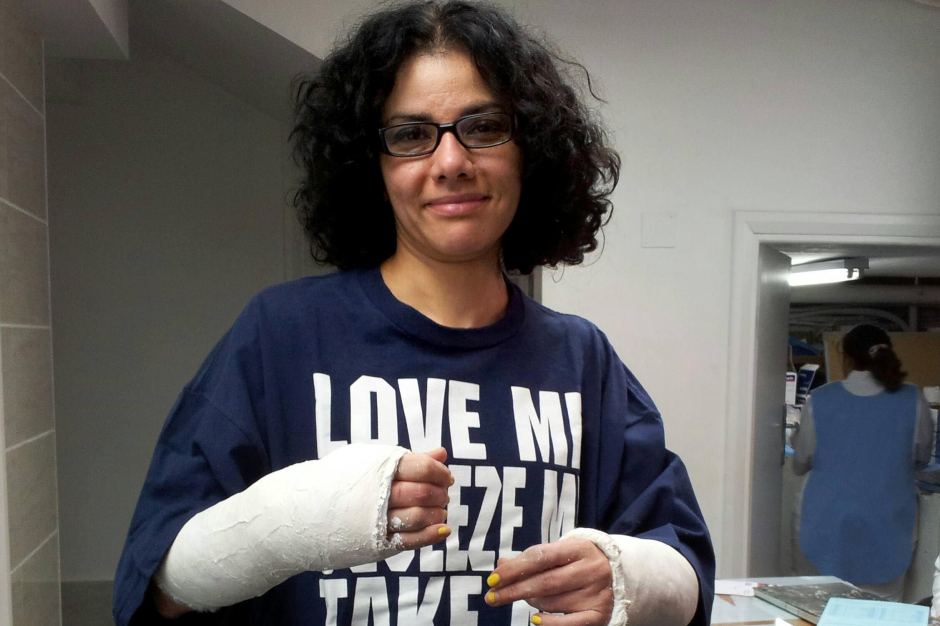
Mona Eltahawy
is an Egyptian-American columnist. In November 2011, Egyptian police beat her, breaking her left arm and right hand, and sexually assaulted her. She was detained by the Interior Ministry and military intelligence for 12 hours.

The original article published in Foreign Policy MAY/JUNE 2012 can be found HERE


Saturday, October 15, 2011

The Cairo Revolution is Far from Over: the Egyptian Women's Revolution has Only Just Begun - By Evita Mouawad

Shahira Amin at the Amerikahaus
By Evita Mouawad, Program and Communications Officer for MENA at Women without Borders/SAVE

Contrary to popular belief, the revolution in Egypt is far from over. In fact, the military's repression of Coptic protests in Cairo last Sunday can be described as the most violent incident since the overthrow of the Mubarak regime last February. Twenty five died and more than 300 were injured as soldiers drove their vehicles into crowds of protesters demanding to know the truth about the attack on a church in Aswan last month.

The Coptic Christians are not the only ones still fighting for their rights in the country, Egyptian women are also struggling to be treated as equals to their male counterparts. Issues such as the continuation of the Egyptian revolution and the role of women in post-revolution Egypt were discussed on Thursday by renowned Egyptian journalist Shahira Amin. The event entitled 'Post-revolution Egypt: Inclusive Democracy in the Making, A Journalist's View' was organized by the international advocacy group Women without Borders and their Sisters Against Violent Extremism (SAVE) initiative, in cooperation with the American Embassy in Austria.

In February 2011, at the height of the Egyptian revolution, Amin's face was seen on television screens around the world, as she resigned from her post of senior correspondent for state-run Nile TV on live television. While supporters of the Mubarak regime stormed Tahrir Square and began attacking protesters, Amin was given a script to read that made no mention of what was happening that very moment outside her studio, and so, she simply walked out.

Today, Amin has become a symbol of the continuing fight for freedom of the press in her country. "I find it tragic that in post-revolution Egypt civilians would get killed for simply expressing their demands which are very legitimate. Their church had been torched and they were calling for the protection of their places of worship" said Amin, referring to the recent Coptic protests.

As for the role of women in her country, Amin stated that, while female political participation remains considerably low, it is undeniable that Egyptian women played a major role in the revolution that ousted Mubarak's 30 year old regime after just 18 days of protests. "Let's not forget that it was young female activists, like Israa Abdel Fattah and Asmaa Mahfouz, who instigated the mass uprising, by posting videos of police brutality on Facebook." she said.

Nonetheless, shortly after the ousting of Mubarak, women activists realized that their fight was far form over. After the interim government formed what Amin dubbed a 'committee of so-called wise men' to draft the first constitutional amendments, not a single woman was invited to take part. As for today, there is only one woman minister in Egypt.

Furthermore, women who were celebrating Women's Day in Tahrir Square on the 8th of March were physically assaulted. Amin said the women "were humiliated by what we were led to believe were conservative bearded men who shouted 'go home where you belong'." But the journalist believes that in reality these men were 'thugs' hired by the remnance of the old regime to 'scare' women away from the political scene.

The journalist also denounced the 'virginity tests' that were conducted by the military on seventeen female protesters who were arrested in Tahrir Square in March. Amin interviewed one of the generals of the Supreme Council of the Armed Forces two months after these tests allegedly occurred, and when asked if the rumours were true, the general claimed the military had done it in self defense, so that the  imprisoned women could not later claim they were sexually assaulted by the army. "As if this wasn't sexual assault already" said Amin.    

Amin also urged the West to adopt a more ‘balanced’ attitude towards the region as other revolutions that have occurred in countries like Bahrain, Saudi Arabia and of course Syria have been more or less ignored.

Women whitout Borders founder Edit Schlaffer & Shahira Amin
Despite the post-revolution setbacks, Amin applauded the fact that female candidate Bouthayna Kamel is running for president in Egypt. "She knows she may not win, because society is simply not ready for a female president yet. But at least Bouthayna has shattered the glass ceiling for all women who wish to run for president in the future" she said, making it clear that the Egyptian women are certainly not planning on giving up the fight.


Flash Points: Edit Schlaffer presents SAVE on CBS