SAVE breaks through the barriers of nationalism, religion, and ethnicity to create a global network of women dedicated to creating a united front against violent extremism
Yesterday, SAVE Sisters and women leaders from around the world sent in their statements of solidarity with the families of victims of Wednesday's bombings in Mumbai. Further statements continue to flow in, showing the strength of international support.
Arshi Saleem Hashmi, Assistant Professor, Department of Peace and Conflict Studies, National Defence University (NDU), Karachi, Pakistan
It is indeed sad to see innocent people becoming the target of those who define humans as mere objects of their cruelty and means to achieve their goals. People dying in Pakistan or India, in Afghanistan or Israel or Palestine - it is not just those who lose their lives but hundreds of associated human lives that suffer every day. The only way to counter these acts of cowardliness is to defy their goal; that is, instead of surrendering to this game of death, we must continue to move forward, and women, more than men, need to take the family forward in defeating them through their resolve. Terrorism succeeds when the other side gives up the fight. Just like Pakistani women who, after every act of terrorism, come out and convince their families to continue their life and not to give up, Indian women are a source of strength and we Pakistanis admire Indian women who challenge and resist any act of injustice and violence. I am sure that this time as well, Indian women will encourage their families to fight violent extremism through collective efforts.
Phyllis Rodriguez, Families for Peaceful Tomorrows, USA
As the mother of a victim of the attacks on the World Trade Center in NYC on 9/11/01, I am deeply saddened by this attack in Mumbai. The rich and long tradition of nonviolence in India makes it all the more disturbing. Re-evaluation of domestic and international policies, plus negotiation, diplomacy and intelligence work are the only meaningful ways to lessen the incidence of such extremist acts. Women can be leaders in this.
Saba Naqvi, Senior Writer, Outlook News Magazine, Delhi
We have been mostly free of the terror and communal debate for the last few years. An event like this is not just tragic because of the horror and the lives lost and damaged, but because it opens the fault lines for communal mobilization. We should not ignore the fact that in recent years Hindu terror groups were found responsible for strikes that were originally blamed on Muslim terrorists. As far as the terror paradigm goes we must keep an open mind. Whoever is behind this it is a great tragedy for a great city like Mumbai to again face this. Mumbai will again endure, survive, and rise above small passions to get down to business. Samia Al-Haddad, Yemeni Organization for Development and Rehabilitation
The Yemen Organization strongly condemns the outrageous attacks in Mumbai, which took place Wednesday evening, killing 21 people and injuring 113 others. We call upon all regional and international organizations and all the decent people and governments of the world in the East and the West to support Indian efforts to overcome these deplorable terrorist attacks, and to support all countries that are a target to such crimes, mass murders and human rights violations.
Juliann Campbell, Journalist, Derry Journal, Northern Ireland
Obviously this is a tragedy for all concerned and the widespread devastation and fear caused by these latest blasts will last much longer than any clean up operation or police investigation. The international community should unite in condemnation against these terrorists and support the people of Mumbai as much as they possibly can. Violence solves nothing. Discussion and a shared sense of compromise can solve many problems.
Catherine Cooke, Foyle Womens Information Network, Northern Ireland I am sad and disgusted to hear of the blasts in Mumbai on Wednesday the 13th July 2011 – I send my heartfelt wishes of love, sympathy and sincerity to all those affected by the blasts - We all suffer when freedom is threatened and we are resigned to look over our shoulders again – I would like the women of the world to say enough is enough and we need to double our efforts in building the peace globally!
Yesterday, three bombs exploded in Mumbai, India, killing at least 18 people and injuring more than 100, in the fourth terrorist attacks on India’s financial capital since 2003. Two and a half years ago, on 26 November 2008, 164 people lost their lives as terrorists invaded the city in a series of coordinated bombing and shooting attacks. For SAVE, Mumbai has a special significance, because it was on that day in 2008 that we held our first international conference, bringing 33 women from around the world together to strategize on new ways to counter violent extremism.
Yesterday’s attacks are a reminder of the importance of the SAVE mission. Mumbai unfortunately seems to be just as vulnerable today as during the fateful days of 26/11. We must recognize the need for smart security that does not rely solely on military or police responses. Prevention of terrorism begins at the community level, where frustrations, anger and disillusion take root. Women can be key allies in educating the next generation to take the non-violent response and to bridge divides rather than exacerbate them. SAVE is currently running the Mothers for Change! Confidence and Computer training workshop in Mumbai with women whose relatives were on duty as police officers during the 26/11 terror attacks. The workshop is an integrated confidence-building, peace education and income-generation program. The program allows women to bring something to the table, therefore increasing their decision-making power in the home, while also teaching them mediation techniques and encouraging them to intervene when youth show signs of radicalization. This pilot program is a first step in the step-by-step process of changing attitudes.
SAVE Sisters and women leaders around the world raise their voices against violent extremism and the latest attacks in Mumbai.
Archana Kapoor, SAVE India
Archana Kapoor, SAVE India
Archana Kapoor was in Mumbai yesterday coordinating the SAVE Mothers for Change! Confidence and Computer Training workshop.
I or any of the women I work with could have been a victim of the 13/7 terror attack in Mumbai. I am so glad that my trainees, trainers and I are safe. But what about those 18 casualties and their families? The 150 injured? On July 12, the day before the attacks, I spent a lot of time thinking about how to commemorate the anniversary of 26/11. A lot of people I talked to were not convinced about doing another event. It seemed that many more people were losing their lives in accidents. But this attack on a normal day, on an otherwise peaceful day, has made us all sit up and think again. Acts of terror and extremism confront us every day, and we cannot just sit back and thank God for keeping us and our close ones safe. SAVE India works towards empowering women to say NO to extremism. It is in this spirit that SAVE started the Mothers for Change! Confidence and Computer Training. The resilience of the women of Mumbai is apparent through the 100% attendance in all three of our classes today.
Dr. Kanchana Mahadevan, Reader, Department of Philosophy, University of Mumbai
These blasts are reminders of how our lives are fragile and deeply interconnected. Like the previous instances, yesterday's violent acts too are perhaps skewed ways of settling scores for not getting justice in courts of law. The people who have died and who have been hurt are suffering for the wrongs that have been perpetuated by others. Our responses have to be empathetic and balanced. Besides helping the victims, what we also need are efforts to build confidence amidst diverse communities, so that such violence is abandoned. For this we need the courts of law to deliver justice, we need jobs, we need cultures that cut across communal lines. Mumbai has risen to such confidence-building in the past - it did so yesterday, it will continue to do so in the future. Citizens- women in particular- have taken the lead in constructing such multiple spaces. All of us have to continue with these measures, and keep our resilience and compassion alive.
Seema Mustafa, Journalist and Television Presenter, Delhi
The government has to be commended for not making wild guesses, as politicians usually do, as to who is behind the attack. But one can say with almost total certainty that once the wails of the victims and their relatives subside, the planted stories aimed at dividing society will start appearing in the media. It is important now for the Opposition to be responsible and not make statements that polarize sentiment along communal lines. Who did it is of course an important question, more so as no organization has claimed responsibility. But given the fact that the Indian investigating agencies have chased shadows for years before realizing entirely different organizations for responsible for attacks such as the Mecca Masjid blasts, the Samjhauta train blasts, it is important for the authorities to establish facts before addressing the media. Scores of innocent persons were arrested, tortured and maimed in custody for crimes they had not committed. This creates tensions that cut into the secular fabric of the country, and this must be avoided. The aftermath of a terror attack, if badly handled, can have long term repercussions as devastating for a wounded country as the blast itself. Professor Anuradha M. Chenoy, Professor of International Relations at Jawharlal University and Author of Militarism and Women in South Asia, Delhi
The bomb blasts in Mumbai, last evening, have traumatized the city and India once again. The purpose of the terrorists remains the same: To create public fear in communities against each other, so that people retreat from secular public spaces into primary identity groups that extract their loyalty and obedience. Fundamentalists use terror for mind control. Controlling the autonomy of women, liberal ideas and peace activists is a critical part of their agenda. It should come as no surprise that India-Pakistan foreign secretary peace talks are to be held next week. Fundamentalist are scared of peace, because it decreases their power and role. State responses should not be the only counter to non-state terrorist groups, because binaries exclude other voices. Rakshanda Jalil, Author, Delhi
This mindlessness has to stop. We have to pluck ourselves off the downward spiral that leads to violence and more violence.
Pamela Philipose, Senior Journalist and Director of Women’s Feature Service (WFS), Delhi
Every time the residents of Mumbai emerge from the trauma of multiple attacks, they are laid low yet again in a pattern that has now become horribly familiar. The attempt now, as always, is to terrorize and demoralize people, pit community against community, create a general climate of fear and undermine the well-being of millions of women and men who want nothing but to carry on with their lives in their chosen city. Such moments demand the coming together of all those committed to human security. They need to speak out against such heinous attacks and condemn terrorism of all kinds, whether by individuals, criminal groups, political outfits or state actors. The region needs to hear their voices as they continue in their efforts to build peace – not in the abstract but as a force that can transform ordinary lives and defeat projects based on spreading fear and hatred.
Shobhaa De, Author of the Column “Politically Incorrect” in The Times of India, Bestselling Novelist and Journalist, Mumbai
I am convinced there is something seriously wrong with us, the people of Mumbai. We are the ‘most attacked’ city on earth… and we accept this dubious ‘honor’ passively, like it is a part of our collective destiny to be frequently bombed. This is not stoicism, it is not resignation, and it most certainly isn’t resilience. So what is it? We think we are being heroic when we react like this when, in fact, we are being foolish. We do nothing about this sorry state of affairs and carry on like blasts are ‘normal’. And they are going to keep bombing us. You know why? Because they can. We refuse to hold anybody responsible. We refuse to make anybody answerable. We refuse to protest. What do we do instead? We show off! We get back to business as usual within hours of an attack and boast about it to the world. As if it’s something to be deliriously proud of. The facts are slightly different. Mumbai is attacked over and over again for the simple reason that it is POSSIBLE!
Mossarat Qadeem, SAVE Pakistan
Mossarat Qadeem, SAVE
Pakistan
We in Pakistan share our solidarity and sympathy with those who lost loved ones yesterday. Pakistan is affected by terrorism daily, and we do not want anyone to suffer the way we suffer. Women are the most affected by conflict and violence, and it is time for the women of India and Pakistan to come together and make a pledge to address violent extremism. Women must start working on their home ground through advocacy, education and creation of awareness for peaceful resolutions. We must build trust between our countries. The international community should come forward and pressure the governments of South Asia to deal with these incidents with maturity. India and Pakistan must join hands and understand the roots of the problem to try to resolve it together, rather than blaming one another. Maureen Fox, SAVE Northern Ireland
Maureen Fox, SAVE Northern Ireland
Fellow Survivors, I am disgusted and appalled by the blasts in Mumbai on Wednesday 13 July 2011, happening in a week that already marks the fifth anniversary of the Mumbai Train Blasts. I send my love and thoughts to ALL who have been affected by this tragedy; the mothers who have lost their sons or husbands, the daughters who have lost their father or brother or sister. You are not alone! I am sad - I am sad because I am neither shocked or surprised. Is this what we have become? Is this our 'normal' existence? This language of bombs, hurt and death is a 'disease' in our world. Who is next? Is it you? or your family? What choices can we make to change this violence, this mindset, this way of life?
This, my sisters is OUR world, when our child is sick we want to cure them, when our family is hungry we want to feed them, when our friends are in need we want to help them, and we can! Let's help our world to rid itself of this global disease. Use our voices and lead by example. When we educate our children, we educate our family, when we educate our family, we educate a community. Educate a community and you can educate a nation. Educate a nation? Well, that's where we go global! Together we WILL be heard.
Anne Carr, Dialogue Practioner, SAVE Northern Ireland
My heart goes out to the wonderful people of Mumbai in the aftermath of another senseless, brutal attack on their people. I was so privileged to spend a very special week with women and children who had been bereaved and injured in the previous attacks on Mumbai, helping them to share their stories and learn with, care with, understand with one another whatever their background, whatever their faith, women so brave and so violated through violence. I stand close to you all today and to those families again having to come to terms with this latest vicious attack on humanity. Women of the world will continue to work together tirelessly and with absolute resolve to build a global community with a special place for everyone, where there is ease with difference and where our children can grow up free from the disastrous realities of violence in all its forms.
Shaimaa Abdel Fattah, SAVE Egypt
Shaimaa Abdel Fattah, SAVE Egypt
Such attacks are only the result of ignorance and ruthlessness. There is no justification whatsoever for murdering innocent citizens. None of the religious sects support violence per se. It's our role now, to fight terrorism in all its forms and condemn those guilty of it. I take this chance to extend my condolences to the crisis-stricken families and promise to be a part of making this world a better place for us to live in. Shahira Amin, Journalist, Egypt
I was deeply shocked to hear about the blasts in Mumbai. We have seen the power of peaceful protests, so no one can condone this kind of violence. I am sure that it won’t realize the goals of whatever these terrorists were trying to achieve. Violence only breeds more violence. It’s really regrettable that some people are still resorting to violence, for the killing of innocent civilians will never succeed in achieving any goals. I feel very strongly about this because we have seen the power of peaceful protests.
Dina Sadek, Journalist, Egypt
Those people [who carried out the attacks] are programmed to believe that what they are doing is the right thing, and that is the real problem here. They justify their terrorism attacks as “for the sake of God”, but God himself said in the Quran “God never changes the condition of a people until they change within themselves”. Nothing will change unless those people understand religion the way it is supposed to be, rather than their messy interpretation of it. Hibaaq Osman, SAVE Board Member, Egypt
There is absolutely no justification for killing innocent people. Everyone should make a strong statement against such acts. Acts of terrorism do not only occur in India or Afghanistan, they could happen anywhere. No one is safe. This was not an act of justice; it was an act of murder. We need to call it what it is.
Robi Damelin, SAVE Israel
How many more people must die, how many more bombs must explode, how many more bereaved families need to be created before we all recognize that the nonviolent way is the only way to achieve a goal? It is time for women from every corner of the world to say enough. We all must say enough.
SAVE brought Hayati Eka Laksmi from Indonesia to Vienna in June for the Mothers MOVE conference. This is her story, published first by Common Ground News Service.
On the day of the Bali bombing in 2002, Hayati Eka Laksmi received a call from a representative of a car rental firm. The car her husband rented with some friends had been caught in traffic in the nearby tourist district of Kuta and a bomb had exploded just three vehicles away.
Eka had already heard about the bombing, but it never crossed her mind that her husband could have been affected. Her initial horror that a group could perpetrate such an attack in the name of Islam gave way to personal grief. She began a frantic search for information, trying to find out if her husband was still alive.
It took seven days before Eka found her husband’s body lying in a mortuary. “I had to identify his body based on marks pointed out by the forensic team and through DNA testing,” said Eka. “I was deeply shocked when it was confirmed that ‘Mr. X’ in Bag Number 145 was the body of my husband.”
The loss of her husband left Eka to bring up her two young sons on her own. “I relied on my husband’s income. My two boys were very young at the time, two and three years old. We were all deeply affected. I became traumatised and depressed.”
Eka noticed that her children were also becoming angry, sad and sometimes aggressive. On the first anniversary of the bombing, she felt that she must do something to move her family out of the grief into which they had sunk.
For six months, Eka received counselling from at a non-governmental organisation that actively helps survivors and victims’ families. Once she completed therapy, the organisation asked her to start working for them, which allowed her to earn some money. Like many women affected by terrorism, she had lost the household’s main breadwinner, and struggled to keep the family going economically. With the help of her mother, she opened a small shop selling domestic goods like sugar, coffee and gas.
Once she had resolved the most pressing needs of everyday life, Eka turned to the emotional needs of her children, taking them to counselling. She recognised that many families were going through the same trauma, and decided to bring friends who had also lost relatives in the bombings to counselling as well.
Gradually, Eka helped create a network of victims called Isana Dewata (Wives Husbands Children of Victims of the Bali Bombings). Through discussion and mutual support, victims were able to find the strength and spirit to overcome their hardships and turn their grief into positive action. The group now consists of 22 families, including 47 children.
The Bali bombings killed people from 22 countries around the world and from several different religions.
Eka recently travelled to Vienna for the Mothers MOVE conference, organised by SAVE-Sisters Against Violent Extremism, the world’s first female counter-terrorism platform. SAVE aims to break through barriers of nationalism, religion and ethnicity to create a global network of women dedicated to ending violent extremism, and to highlight the voices of victims to expose the human cost of terrorism.
In Vienna, Eka joined women from Nigeria, Yemen, Egypt, Pakistan, Palestine, Israel and Northern Ireland, all of whom have lost relatives to terrorism or who are working actively to counter violent extremism. Eka shared her own story and learnt from the experiences of others. Over the three days, the women built up an intimate trust. They gained inspiration from each other’s stories and recognised that even across cultures, the pain a mother feels on losing a husband or child is the same.
Eka recognises that a mother’s influence is very important: “Mothers are the basis of the family. [A mother] can give her children direction. Those children who were affected by the Bali bombing might have anger in their hearts. Mothers can explain to them that it is no good to seek revenge. Through cooperation with other mothers, women can better support their children.”
“My children’s lives were changed because of cowards who acted in the name of religion, but these bombings are not about religion,” Eka adds. “Islam does not teach us to kill each other. Religion is a basic need, and it is my foundation for life. I have learnt to appreciate the blessings that God has given to us and accept all of this with a sincere heart and without a grudge against anyone, not even against the terrorists who killed my husband.”
MANAMA, Apr 22 (IPS) - Women in Bahrain have launched new initiatives to tackle sectarian tensions that emerged as the fallout of widespread unrest sweeping the country since Feb. 14.
The tiny island with oil incomes representing around 70 percent of government revenues was known for years for its peaceful coexistence between its majority Shiite and minority Sunni populations.
The majority of those who participated in demonstrations before the declaration of the three-month state of emergency in March were Shiites. Sunnis were mainly involved in pro-government rallies.
The result: long-time friends have turned enemies. Each sect has issued a list of shops that should be boycotted because Bahrainis of the opposite sect own them. Those lists are circulated through leaflets, email and e-forums.
‘Women for Bahrain’ is an initiative that is working to unite Bahrainis once again. "Through the group we are trying to tell people that religion is for god, and the country is for all of us, and how sectarianism could lead to serious complications," activist and member of the media committee Fawziya Al Khaja told IPS.
The recently formed women’s group of different walks of life stands against powers in Bahrain backing sectarian tension to promote their agendas, she says.
The group commenced its activities in March, calling for love and tolerance through Internet social networks. A unity petition was launched.
A gathering in the same month followed the call for love and tolerance. It promoted meditation and other exercises.
"The group’s activities wouldn’t have a timeframe and would continue as long as we are needed, we want from the people of Bahrain to respect and accept each other regardless of their differences and to share the love of their country," Al Khaja says.
The group is also dedicated to spreading the principles of wisdom, justice and freedom to protect the dignity of people. "Through the group we are telling society and the world that the role of Bahraini women shouldn’t be overlooked, as without them the structure of family and community get affected," she explains.
Internet social networks and Blackberry messenger are now a war zone for Shiite and Sunni youth who pass hate messages back and forth constantly. Those messages criticise the differences among two sects of the same religion, president of the Bahrain Women’s Union Mariam Al Ruwaee, tells IPS.
"Mixed marriages felt the heat of tensions most, since people could shun sectarianism inside their homes, while we are confronting them insides our bedrooms," Fathiya Ibrahim, a Shiite, told IPS.
Talking about her relationship with her Sunni husband, she said: "We aren’t at ease as we share different opinions. It wasn’t like that before but situations have dragged us to this level."
Sunni academic, Haisa Al Junaid who is married to a Shiite, has so far attracted 40 women to stand together against what could threaten the stability of their families and the safety of their children - fights that turn violent at schools.
"We want to take legal actions, including filing court cases against well-known figures promoting sectarianism," Haisa announced during a recent launch of the initiative at her home.
"Through the group we want also to highlight that we are in pain from disunity in the community and disturbance of relations."
Unconfirmed reports surfaced today that a female poet who recited her anti-government poems in Pearl Square had died after enduring torture. She remains missing.
Twenty-year-old Ayat al-Ghermezi was actively involved in the peaceful protests against Bahrain’s authoritarian government led by King Hamad bin Isa. When the government’s response to the demonstrations turned violent in mid March, security forces searched Ghermezi’s home and threatened her family until they revealed her whereabouts. She was arrested shortly afterwards. Her death was reported today, although it was later claimed that the news is a leak by the Bahrain government to discredit media. Bahrain is currently under a media blackout enforced by the government.
Bahrain’s government continues to abduct both female and male protesters and human rights activists. On Monday, six female teachers and several pupils were arrested at a school in Hamad. Teachers have gone on strike several times since the beginning of demonstrations in Bahrain on February 14, to show solidarity with the aims of the protest movements. The Education Ministry has responded by setting up a committee to take action against administration staff and teachers who are active in the protests and strikes. Security forces have further abducted medical staff from several medical centres. Human Rights Watch has estimated that at least 400 activists have gone missing since the beginning of the government crack-down on March 14.
Bahraini youth began a mass hunger strike on March 18 to show their rejection of the abuses of human rights currently underway in their country. They are following the example of Zainab Alkhawaja, daughter of human rights activist Abdulhadi Al-Khawaja, who is now on her eighth day of hunger strike.
Bahrain’s government is receiving support from Saudi Arabian, Kuwaiti and United Arab Emirate forces in an attempt to quell pro-democracy uprisings. The response of the international community to the violence in Bahrain has been lukewarm in comparison to previous responses in countries such as Libya and Egypt. Hesitation over the situation in Bahrain is damaging the image of Western governments in some quarters of the Arab world, as the USA is associated by many with Saudi Arabia’s government.
Petitions asking the UN, EU, USA and UK governments to take a firmer stance to dissuade the government in Bahrain from violating human rights are operating online.
Through the peaceful and democratic process of letter-writing, you can bring your concern over the situation in Bahrain, especially in regard to the deaths of human rights activists and the detention of pregnant women and children, to the attention of decision-makers around the world. For more information about the human rights situation in Bahrain, visit Human Rights Watch.
United States of America: To find and contact your representative in the USA click here, or contact the White House here.
United Kingdom: To find and contact your MP in the UK click here, or to write to the Prime Minister click here.
Austria: To contact your representative in the Austrian Parliament click here.
EU: To contact your representative in the European Parliament, click here.
SANAA, Yemen — Yemen's anti-government movement took up the issue of women's rights in the conservative Muslim nation on Saturday, as thousands of demonstrators seeking the president's ouster denounced his comments against the participation of women in protest rallies.
In a speech Friday, President Ali Abdullah Saleh said the mingling of men and women at protests in the capital was against Islamic law. Demonstrators, including thousands of women, responded by marching through the capital of Sanaa and several other cities, shouting: "Saleh, beware of injuring women's honor."
"This insult has made us more determined to remain at the opposition squares with the men to topple the ugly regime," said Jameela al-Qabsi, a female professor at an education college.
Though it was a young woman who first led anti-Saleh demonstrations on a university campus in late January, women didn't begin turning out in large numbers until early March. It was a startling step considering the Muslim nation is a largely tribal society with deeply conservative social and religious traditions.
Many Yemeni women remain out of sight and conceal themselves in public under black head-to-toe robes. The issue of child brides in Yemen has also drawn international criticism. But unlike in neighboring Saudi Arabia, women in Yemen are permitted to vote, run for parliament and drive cars.
Two months of near-daily protests and defections by key allies in the military, powerful tribes and diplomatic corps have failed to bring an end to Saleh's 32-year autocratic rule over the impoverished and fragile nation in the Arabian peninsula.
A crackdown on protesters by Saleh's forces has killed more than 120 people, according to Yemeni rights groups, but has not deterred crowds from gathering.
On Saturday, a group of female protesters presented the chief prosecutor with a complaint against Saleh for his remarks. Amat al-Salam Abdullah, one of the protesters, said the prosecutor ordered an investigation.
"I don't rule out that the president has been traumatized as a result of the involvement of tens of thousands of women in the demonstrations calling for his downfall," said Faiza al-Sharji, a female university professor.
The youth movement leading the anti-government protests took up the women's cause, calling for people to come out in millions on Sunday for a day of "honor and dignity."
The youth movement said in a statement that Saleh's comments were "a continuation of his violations against the Yemeni people after he killed them and accused them of being agents and outlaws."
Advocacy for women's rights in Yemen is rooted in the 1967-1990 period when the once-independent south had a socialist government. After unification, women in the south became more marginalized, resulting in high unemployment among female university graduates.
Washington, DC - In Libya, Egypt, Bahrain, Yemen, Tunisia and elsewhere, women have stood with men pushing for change. In Libya, Iman and Salwa Bagaighif are helping lead, shape and support protesters. And in Egypt, the Egyptian Organization for Human Rights, one of the oldest and most well-known non-governmental organisations in Egypt, estimated that at least 20 per cent of the protesters were women.
For example, the 26-year-old co-founder of Egypt’s April 6 Youth Movement, Asmaa Mahfouz, mobilised thousands of youth in support of the protest through her impassioned YouTube video. In Yemen, a 32-year-old mother of three, Tawakkul Karman, helped organise protests against the current government.
Yet women's leadership in 2011 is not a new phenomenon. In Iran, women have for many years successfully pushed for greater freedom in personal status law, and greater employment and educational opportunities. Many Iranian women have been imprisoned simply for endorsing the Million Signature Campaign, which seeks equal rights and the repeal of laws that discriminate against women.
Women have been using social media and leveraged communications technology to pursue greater social and political openness since before the arrival of Iranian President Mahmoud Ahmadinejad. Notwithstanding a rich history of non-violent activism and extraordinary leadership, women have rarely been involved in political decision-making in the Middle East and North Africa region.
At an even more basic level, women do not feel confident that their rights will be preserved under the systems emerging from recent political transformations.
In Iraq, there have been female judges since the 1950s and thus many of women’s rights have been protected since 1978 by a personal status law. Yet in 2003, the new Iraqi Governing Council sought to strip women of these rights. Only in the face of domestic petitions, letter writing and face-to-face advocacy were women successful in ensuring their rights were preserved. Iraqi women continue to face efforts to reduce their freedoms and each time they have defeated the assault.
Already Egyptian women are risking similar marginalisation. There are no women on the committee revising the constitution. In an almost uncanny parallel to the struggle of Iraqi women after former Iraqi President Saddam Hussein, Egyptians have drafted a petition, endorsed by over 60 local organisations, decrying women's absence from transitional political bodies.
Bias embedded in the new draft constitution suggests that these concerns may be real.
The international community and the new generation of progressive, democracy-minded leaders in the Middle East need to see women as critical partners for change. The evidence is undisputable. The 2005 UN Arab Human Development Report cautions that under-employment and under-investment in women severely drains overall well-being and concludes that "the rise of women is in fact a prerequisite for an Arab renaissance, inseparably and causally linked to the fate of the Arab world."
The world has an unprecedented opportunity to transform nations held down for decades by oppressive regimes. We must make sure that this opportunity is open to all citizens, including women.
Women’s role must be honoured in the struggle and protect against the fundamentalist push. Most importantly, their involvement will be key to enabling pluralistic, economically thriving societies to emerge in a region whose progress has been stalled for generations.
The window is small but the time is now and the opportunity is enormous. As we celebrate the 100th anniversary of International Women's Day on 8 March, let's remember how critical advancing the status of women will be to success.
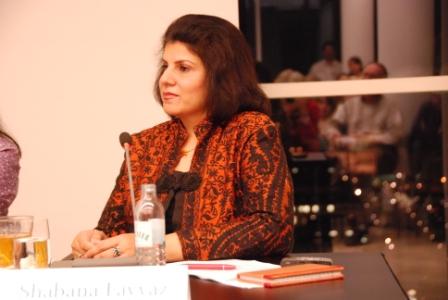
Shabana Fayyaz taking part in the SAVE Women's Dialogue
Shabana Fayyaz, SAVE Pakistan representative and Assistant Proffessor at the Defense and Strategic Studies Department of Quaid-i-Azam University in Islamabad, reflects on the critical role of women in combatting extremism in Pakistan, and on the inclusive teachings of Quaid, founder of Pakistan.
In Pakistan women deserve a critical role to play at the state/society policy shaping and making level. Women in Pakistan constitute more than half of the country's population. Female icons since the creation of our country have played and continue to play a decisive role on all fronts - yet their role as 'agents of change' remains under-appreciated, both by themselves as well as state/society at large.
The SAVE Pakistan chapter is a step in the right direction to make unheard stories of women’s contributions known. Women’s role in ‘social cohesion’ needs to be registered through multi-track interventions. That is, investing in the training and capacity building of existing women-based networks to counter extremism at the micro and macro level.
There exists a critical gap in the existing indigenous literature on women and extremism accompanied by a tendency to frame women as ‘victims’ and not recognizing their role as ‘healers’ in society. By following a victimhood lens, the women are mostly reduced to being either a ‘sufferer’ or a ‘silent spectator’, ignoring the ground realities. The fact of the matter is that women have a central role simultaneously at the family and at the community level. At times, particularly in the case of SWAT, it was womenfolk that served as a critical fund-raiser plus a victim of Maulana Fazlullah’s so-called ‘Islamization’ drive. Many mothers were aware of their sons’, brothers’ and husbands’ radical tendencies but looked the other way purposefully, thinking that it would lead to an equitable and just society - as pronounced by Maulana Fazlullah’s in his sermons through a mobile radio network in the area.
The role of women in curtailing, spreading and tolerating extremism in Pakistan remains an under-researched area. There is an abundance of contemporary literature on the genesis of extremism in the country but focus on women as an equal stake-holder in the policy-making and shaping arena remains untouched. There exists a niche to critically focus on sensitizing women leaders from all over the country on how to build and nurture their role as “agents of change” through team-building initiatives. And it is only through informed debate, dialogue and discussion that an inductive and inclusive counter-extremism policy can be shaped.
As it is often said, who will bell the cat? It is state and society together. The extremism and terrorism facing Pakistan falls in between traditional and non-traditional security challenges. It requires an inductive and sustainable response on the home front. That is, optimal use of women as key stake holder in response to radicalization, extremism and political violence. In this enterprise, media (including print, television, radio, and on-line) has the capacity to be a ‘change-maker’ in airing not only the stories told through the ‘victimhood lens’ but also highlighting the on-going efforts of the courageous women leaders on the ground against religious, cultural and political extremism. Parallel to this, learning and sharing the best practices on how women became an agent of change for sustainable peace in all parts of the world should be encouraged.
In conclusion, women facing and fighting extremism need to be recognized as viable and critical partners in the fight against the quagmire of extremism in Pakistan. That is, we need to reclaim Quaid’s vision of a moderate and progressive Pakistan, whereby a woman is an essential stake holder in the policy making arena. Now is the time to rectify our earlier deeds, when women’s activism was/is perceived as a threat to the so-called social, cultural and religious underpinnings of a stable Pakistan. In conclusion, the following words of Quaid - the founder of Pakistan, (in a speech at the Islamia College for women on 25 March 1940) are worth recalling:
“I have always maintained that no nation can ever be worthy of its existence that cannot take its women along with the men. No struggle can ever succeed without women participating side by side with men. There are two powers in the world; one is the sword and the other is the pen. There is a great competition and rivalry between the two. There is a third power stronger than both, that of the women”.