Showing posts with label Taliban. Show all posts

Thursday, October 18, 2012

New details on Malala's case, giving an insight into Pakistan's lose Taliban policies

While Malala Yousufzai’s condition is stabilizing, details on the attack last week are slowly emerging. According to Reuters, one of the two gunmen involved in the shooting has been identified by his first name. Attaullah, a young man, was arrested in 2009 during the Pakistani military campaign that pushed the Taliban out of the Swat Valley. Due to a lack of evidence of connections to terrorist groups, he was released after only three months. However, a senior security official is refuting this statement, indicating that authorities reputedly did gather enough evidence to arrest Attaullah when they raided his house in the Swat Valley. According to officials, Attaullah organized the attack on Malala on orders of one of the Taliban's most feared commanders, Maulana Fazlullah, who operated from Afghanistan after the 2009 military raid before returning the Pakistan this past June. Critics say Pakistan's low conviction rate of militants, even high-profile individuals who carried out major attacks, is one reason why extremism has spread in the South Asian nation. Public fury over the shooting has increased pressure on the Pakistani military to mount a major offensive against the Taliban, which has close allegiances to Al Qaeda and a host of other militant groups. The Taliban, fighting to topple the government and impose a radical theocracy, have blown up hundreds of girls’ schools in recent years in Swat and other areas to further their opposition to the education of women.


- Lea von Martius

Thursday, October 11, 2012

Malala Yosufzai: A Ray of Hope for Pakistan, by Arshi Hashmi


The courageous young girl Malala Yosufzai* is the ray of hope for most Pakistanis, especially girls. She not only stood up against Talibanization, but through her writings and speech convinced other girls that they can also dream of education and freedom of expression without any fear. It is so unfortunate that the Taliban attacked her while she was on her way back home from School. They confirmed her identification and then shot at her, which shows that it was clearly a targeted attack. Soon after the attack, Taliban issued a statement and sent it to the media saying that Malala "provoked" the people against the Taliban, which is why she is targeted. The attackers were successful in targeting her, but they had perhaps not realized that their act would create huge resentment and protest in the country. TV channels, newspapers, and the highest authorities, including the chief of army staff Gen Kiyani, visited her at the hospital condemning the attack. Major political parties, both conservative and liberal, held huge prayers for her recovery. School, colleges and universities all had a moment of silence and prayers for her. The more Taliban wanted to create fear in the society, the more people have come up against the act. In Swat,where the attack occurred , common people who were interviewed by private TV channels spoke against the attack. Pakistanis are sad , they are ashamed of not having protected the girl who is confident, full of hope and action for change. This is an important moment, if we as a nation let this pass without any stern action against the Taliban then nobody will ever be able to stand against violent extremism and terrorism in the name of God. Let's hope that the society will continue to speak up against this insanity and break the culture of silence that has been benefiting the extremists. 


*Malala Yosufzai is a 14-year-old women's rights and counter terrorism activist from the Swat Valley who advocated for access to education for girls in the region. Malala's writings have been featured on the BBC and she was the focus on a New York Times documentary; in 2010, Malala was awarded Pakistan's first National Peace Prize.

On October 9, 2012, Taliban shooters boarded the bus carrying her home for school, asked for her by name, and then shot her in the neck and head. She survived the shooting and is currently recovering in a hospital.

Wednesday, July 25, 2012

What Do We Know About Pakistan?

Edit Schlaffer, Founder and
Executive Director of WWB/SAVE
By Edit Schlaffer

Although Pakistan has become a household name in the West, what do we actually know about the country? Military strategists as well as political and social analysts all agree that there is a steady, dangerous downward spiral at every level of society. Pakistan is considered a safe haven for Taliban insurgents, and the country's nuclear capabilities are great cause for concern. Corruption is prevalent; rule of law is the exception and lack of electricity the norm. The majority of the country goes without power for close to 20 hours a day. And "without power" is an apt metaphor for the political system - there is no people's power. The military rules with an iron fist, and violent extremists terrorize vast parts of the country including the capital. 


Last week I traveled to Pakistan and witnessed firsthand its security 
challenges. Equally alarming is the growing intolerance of America and the West. 
Swat Woman
Copyright Women without Borders

Our partner in Islamabad arranged for a group of seven women from the Swat valley - formerly the touristic hope of the country, the so-called "Switzerland" of Pakistan before the Taliban established a stronghold in the area - to travel to Islamabad so that I could speak with them personally and privately. The women, all illiterate housewives with multiple children, told me how they reacted when Fazlullah, locally known as the "Radio Mullah," first arrived in Swat 10 years ago. Fazlullah strategically recognized the power women can wield over their families and communities in the region and was the first to address women directly and call for their support "to fight for their faith and country" through radio sermons. 

In the Swat Valley, an extremely impoverished region, a woman's 
most valuable belongings are her wedding jewelry, which also ensures her status in the community. Women must be married to gain legitimacy within the society. After hearing Fazlullah's fiery addresses, the women of Swat donated their gold wedding bands and necklaces to support his cause, resulting in over two kilograms of gold to finance his jihad. Some even encouraged their sons and husbands to join his group, to supposedly pay their tribute to Islam and Fazlullah's struggle. 

Soon, however, the women realized that Fazlullah only brought violence and misery. Family members who refused to join or publicly disagreed with his ideologies and methods were symbolically and brutally murdered in the street as a bloody warning to others. 

Even in the face of such gruesome threats, the women of Swat are now determined to defeat Fazlullah and the death and destruction he represents. Halda, one of my interview partners, insists: "If Fazlullah comes to our area again and the men fail to stop him, then we women will take up the fight against him." 

It is ironic that it was a Talib who first recognized the potential and power of women in the Swat Valley and to directly and explicitly call on them to support a cause. He tried to use them. But the women soon saw through him when they recognized how his "jihad" was negatively impacting their families, and they demystified the dangers of his ideologies and consequent actions. 

It is now high time for policy makers and strategists to tap into the incredible power of women around the world and to connect with civil society as the primary driver in daily life. 

Ahmed Rashid, the acclaimed expert on Pakistani affairs and the Taliban, entitled his last book "Pakistan on the Brink," with a very interesting subtitle - "The Future of Afghanistan, Pakistan and the West." Our futures are interconnected. Radicalization in distant areas such as the Swat Valley will certainly have global consequences and affect the safety and security of our world. 

These women, who were willing to share their stories with me, are on a mission. They all brought with them pictures of their missing husbands or sons. Their men were generally lured into the terrorist network, and when they tried to escape they were imprisoned by the military. Now they are missing, either dead or in an unknown military prison, and the women are struggling to find even the smallest indication of their whereabouts. In an extremely volatile region, they are looking for certainty. 

Children of Swat Valley
Copyright Women without Borders
The women were accompanied by male guardians on their trip to Islamabad. One was 17 years old and a former Talib; he had been recruited at the age of 12. He has been able to escape the grip of Fazlullah's forces, and his dream is now to study - to learn something and to become somebody, but it will be difficult. He is now solely responsible for feeding, clothing and protecting his female family members, as his older brother and father disappeared - captured either by the military or the Taliban shortly after he returned home. 

Another guardian is an old man, frail with a long beard. When he talks about his five sons who have all disappeared, he starts crying. Showing such emotion is very unusual for a man in his cultural context. He apologizes and says, "I am crying my eyes out. Soon I will be blind. Can blind people cry?" He has accompanied three of his five daughters-in-law to Islamabad, for whom he is the only source of support now. 

The women brought along six young children between them - of course, how could I forget that this could happen? We rush to the market to get a few toys - cars for the boys and princess crowns for the girls, anticipating that this would not be the moment to challenge gender stereotypes. The women were pleased. One woman said to me, "My daughter will wear this on her wedding day." The girl is nine years-old.

This article was originally posted on the Womenetics website on 24 July 2012.

Tuesday, April 19, 2011

"I just want to apologise to my mother"

14-year-old Umar Fidai fell under the influence of the Taliban and targeted innocents in a suicide attack in Pakistan. This article from BBC News tells in his own words how he regrets his actions, and has come to realise that the Taliban's teachings are un-Islamic. The article highlights the need for moderate teachings in vulnerable societies, allowing impressionable youth to learn that there is an alternative to violent extremism. It also shows the importance of empowering family members to recognize early-warning signs of radicalism - had Umar Fidai's parents been aware of their young son's intentions, they would have had the chance to dissuade him.

In early April a suicide blast ripped though a Pakistani shrine packed with thousands of devotees, leaving scores dead. Both attackers were schoolboys in their early teens. But one survived and told the BBC's Aleem Maqbool what made him want to take his life and the lives of others.

"All I was thinking was that I had to detonate myself near as many people as possible. When I decided it was the right time, it was a moment of happiness for me," said 14-year-old Umar Fidai.

"I thought that there would be a little bit of pain, but then I would be in heaven."

Umar did not make it to paradise. Instead, we find him in custody.

His left arm is missing, his right arm entirely strapped up, and there are bandages around his torso. But he is alert, polite and disarmingly frank.

"The plan was that Ismail would blow himself up near the shrine. I would wait for the ambulances to come and detonate myself near them to kill more people. I had no doubts at all beforehand.
But Umar's suicide jacket failed to explode properly.

He blew off his own arm, tore open his abdomen and was knocked unconscious. When he came round, Umar reached for a grenade in his pocket.

"We had been taught that if the belt does not go off, we should kill ourselves with the grenade. There were three policemen standing close by, and I thought if I killed them too, I would still make it to heaven."

As Umar raised the grenade to his mouth to pull out the pin with his teeth, a police officer shot him in the arm.

Extraordinary mobile phone footage shows Umar lying on the ground as police then went about defusing the remains of his suicide jacket.

'Taliban all round'

His journey to get to this point had started five months earlier, in his hometown in the mountainous tribal regions of north-west Pakistan, close to the Afghan border.

Umar Fidai failed to detonate his suicide vest and survived "Where I used to go to school, there were Taliban all around. One day one of them told me to go with him to become a suicide bomber, but I told him if he wanted to kill people he should do it himself, not ask children. But he kept coming back.

"He said there was no point studying. He told me that nothing was better than paradise, and that you could earn that by killing non-believers.

"The Taliban prayed all the time and read the Koran, so I thought they were good people. My heart told me to go and train with them."

Umar said he was blindfolded and sometimes handcuffed when he was taken to the training compound, so he would not be able to reveal its location.

He said he was trained in the use of weapons and explosives with three other boys.

Thousands of Pakistanis have been killed in militant attacks in the past three years.

It is thought that the majority of suicide bombings are now being carried out by children like Umar, trained by the Taliban.

The targets across Pakistan have been diverse, but several recent bombings have been at the shrines of Sufi saints, like the one Umar was involved in.

These shrines have long been a focus of devotion and prayer, but hardline Islamists have decided that worship at them is un-Islamic.

"The Taliban always told us we would go to Afghanistan to kill non-believers," says Umar. "We agreed, because they said that would mean we would go to paradise.

"But when we travelled by bus to the place of our attack, I saw it was still Pakistan so I questioned them. They said the people who pray to the dead at shrines are even bigger infidels, and I believed them.

"When we got to the shrine, Ismail and I went up a hill to a place nobody could see, took our suicide jackets out of our bags, and put them on.

"Then we said our goodbyes and promised we would pray for each other, but we were not sad, because we thought we were going to heaven."

Dozens of injured devotees were rushed to hospital after the attack Umar said it was only when the police were trying to defuse his explosives and when he saw the care the doctors were giving him, that he started to realise he had been wrong.

"I am so grateful, because I have been saved from going to hell. I am in a lot of pain, but I know there are many people in hospital even more severely injured than me and I am so sorry for what I did and for what Ismail did.

"We did a very bad thing by killing children and old men and women. I now realise suicide bombing is un-Islamic. I hope people will forgive me."

Umar told me that nobody from his family had got in touch with him since the attack

"I know my mother and my younger sisters, in North Waziristan, would know what's happened and they must be very upset. I just want to apologise to my mother. But at the time I detonated myself, thoughts of my family were not in my mind, I was only thinking about what the Taliban had taught me."

The attack could still cost Umar his life, he remains seriously ill.

He is also now scared that the Taliban could come to kill him at any time for failing in his suicide mission.

Friday, April 15, 2011

"No struggle can ever succeed without women participating side by side with men"

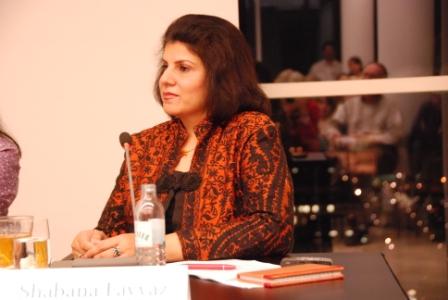
Shabana Fayyaz taking part in the SAVE Women's Dialogue
Shabana Fayyaz, SAVE Pakistan representative and Assistant Proffessor at the Defense and Strategic Studies Department of Quaid-i-Azam University in Islamabad, reflects on the critical role of women in combatting extremism in Pakistan, and on the inclusive teachings of Quaid, founder of Pakistan.

In Pakistan women deserve a critical role to play at the state/society policy shaping and making level. Women in Pakistan constitute more than half of the country's population. Female icons since the creation of our country have played and continue to play a decisive role on all fronts - yet their role as 'agents of change' remains under-appreciated, both by themselves as well as state/society at large.

The SAVE Pakistan chapter is a step in the right direction to make unheard stories of women’s contributions known. Women’s role in ‘social cohesion’ needs to be registered through multi-track interventions. That is, investing in the training and capacity building of existing women-based networks to counter extremism at the micro and macro level.

There exists a critical gap in the existing indigenous literature on women and extremism accompanied by a tendency to frame women as ‘victims’ and not recognizing their role as ‘healers’ in society. By following a victimhood lens, the women are mostly reduced to being either a ‘sufferer’ or a ‘silent spectator’, ignoring the ground realities. The fact of the matter is that women have a central role simultaneously at the family and at the community level. At times, particularly in the case of SWAT, it was womenfolk that served as a critical fund-raiser plus a victim of Maulana Fazlullah’s so-called ‘Islamization’ drive. Many mothers were aware of their sons’, brothers’ and husbands’ radical tendencies but looked the other way purposefully, thinking that it would lead to an equitable and just society - as pronounced by Maulana Fazlullah’s in his sermons through a mobile radio network in the area.

The role of women in curtailing, spreading and tolerating extremism in Pakistan remains an under-researched area. There is an abundance of contemporary literature on the genesis of extremism in the country but focus on women as an equal stake-holder in the policy-making and shaping arena remains untouched. There exists a niche to critically focus on sensitizing women leaders from all over the country on how to build and nurture their role as “agents of change” through team-building initiatives. And it is only through informed debate, dialogue and discussion that an inductive and inclusive counter-extremism policy can be shaped.

As it is often said, who will bell the cat? It is state and society together. The extremism and terrorism facing Pakistan falls in between traditional and non-traditional security challenges. It requires an inductive and sustainable response on the home front. That is, optimal use of women as key stake holder in response to radicalization, extremism and political violence. In this enterprise, media (including print, television, radio, and on-line) has the capacity to be a ‘change-maker’ in airing not only the stories told through the ‘victimhood lens’ but also highlighting the on-going efforts of the courageous women leaders on the ground against religious, cultural and political extremism. Parallel to this, learning and sharing the best practices on how women became an agent of change for sustainable peace in all parts of the world should be encouraged.

In conclusion, women facing and fighting extremism need to be recognized as viable and critical partners in the fight against the quagmire of extremism in Pakistan. That is, we need to reclaim Quaid’s vision of a moderate and progressive Pakistan, whereby a woman is an essential stake holder in the policy making arena. Now is the time to rectify our earlier deeds, when women’s activism was/is perceived as a threat to the so-called social, cultural and religious underpinnings of a stable Pakistan. In conclusion, the following words of Quaid - the founder of Pakistan, (in a speech at the Islamia College for women on 25 March 1940) are worth recalling:

“I have always maintained that no nation can ever be worthy of its existence that cannot take its women along with the men. No struggle can ever succeed without women participating side by side with men. There are two powers in the world; one is the sword and the other is the pen. There is a great competition and rivalry between the two. There is a third power stronger than both, that of the women”.

Tuesday, March 22, 2011

Breaking News: SAVE Yemen

On March 21st, SAVE Global spoke with our Yemeni partner based on the outskirts of Sana’a about recent developments in the capital, how Yemeni youth view the revolution, and her hopes and fears for the coming days.

Daily Life


Maha (name changed), a university-educated woman, explained how her life has changed since this past Friday, when a bloody massacre left over 50 anti-government protesters dead. President Saleh immediately declared a state of emergency in Yemen, which has sought to restrict the movement of individuals and closed public schools and universities (private universities, including the Islamic Iman University, remain open). When she now wants to travel to Sana’a, Maha and her family must pass through a series of checkpoints, a reality she had never before experienced.

The current uprisings throughout Sana’a are beginning to take a severe toll on the Yemeni population, at least in the capital city. Yesterday, many private companies throughout Sana’a asked their employees to return home and remain indoors; as a substantial portion of Yemenis live on less than 2 dollars a day, however, the economic pressures the state of emergency is exerting on the population have led some to defy orders and seek work.

Change, But Who and How?


While hope and a fervent desire for change can be found among the revolutionary Yemeni youth, uncertainty about the future seems to be the pervasive emotion in the homes and camps throughout Sana’a. The resignation of former key government supporters, including a number of government Ministers and Ambassadors, has created a severe sense of unease among the revolutionary population. They also fear that should Saleh fall, his half-brother or another, similarly oppressive leader will seize power, such that a regime shift may occur without any true change or development on the ground.

A significant complicating factor in the Yemeni uprisings is that while the Yemeni youth desire change, they generally support neither the government nor the opposition forces. From the beginning, the opposition group has not pandered to the youth, and the youth did not pledge their support to them. Emblematic of this indecision is the growth of a youth group that calls itself ‘The Youth Group without a Political Party,’ which is currently gaining supporters throughout Sana’a. Maha fears that the majority of the young revolutionaries have no clear idea of what the desired outcome of the uprisings should look like, nor how this change should be achieved.

As in Egypt, no single young leader is emerging out of the unrest; however, unlike in Cairo, with a population of close to 20 million, many of whom are educated, only a small minority of the less than two million people who live in Sana’a are educated. This imbalance is hindering a common formulation of what post-revolution Yemen should look like; the agitation for change, without clear direction or even the present ability of an individual to emerge out of the masses and give direction, raises questions about how successful this movement can be. Maha strongly emphasized that Yemen and Egypt cannot be compared in their revolutionary paths, as Egypt’s revolutionary youths’ very poignant idea of and desire for democracy cannot be found reflected among the Yemeni youth.

Libya

In general, Yemenis support the Allied enforcement of a no-fly zone in Libya; they fear that if President Saleh is not removed, he will become a second Gaddafi. However, Yemenis are very concerned about the humanitarian consequences and are afraid that such external intervention could have a lasting effect on Libya and the Middle East in general. There are fears that the no-fly zone is the beginning of ‘a second Iraq,’ but those who are frustrated with Arab autocrats believe that there should be sacrifices in order to create change. responded that “the Yemenis feel that civilians are likely to die either way, and that it is better for civilians to die at the hands of the Allied forces than at the hands of crazy Gaddafi. They hope that Libyans will ultimately cultivate the fruits of their new revolution. ”

Western Media Focus

Western media have reported that Saleh’s tribe has rescinded his membership; when asked about how strongly this information is featured in the Yemeni media, Maha noted that it was only peripherally mentioned in the Sana’a press. Also of concern is that while the Western media have highlighted the role of Tawakkol Karman, a leading female activist who was kidnapped at the beginning of the unrest and who played a key role in the protests at the University of Sana’a, has been very quiet in recent days, even ending her text message campaign to other activists. Amal al Basha, the Executive Director of the Sisters Arab Forum, is instead slowly emerging as a very loud supporter of change.

Women


Women are playing a significant role in this uprising. They cook and supply food to the protesters, support their husbands, and also take to the streets themselves. Significantly, women and men are mixing in the camps.

Rise of Extremsim

Maha’s friend, a political analyst, yesterday identified Taliban who are beginning to infiltrate these camps. One of their first efforts is to segregate male and female protesters, claiming that the mixing of the genders is against religious law. These initial steps, combined with the Taliban’s growing presence in the camps, raises concerns about the rise of Islamist extremists to fill the vacuum being created by revolutionary agitation with no clear goal or leader.

Facebook


Facebook has become the most important medium for the youthful revolutionaries to communicate and exchange information; very few listen to or watch the news and/or read newspapers. Yesterday, a youth group began posting their demands on a Facebook page.

To read more about the situation on the ground in Yemen, visit the Yemen Times

Further up-to-date information about the uprisings in Yemen can be found on the BBC's website.

Friday, November 5, 2010

Women SAVE Pakistan: Empowering Women to Sensitize and Mobilize Against Extremism, with Mossarat Qadeem


On Thursday, October 21, Mossarat Qadeem, Executive Director of the PAIMAN Trust and SAVE Pakistan Coordinator, spoke on SAVE Pakistan’s activities and the vital role women can play in combating violent extremism at the Austrian Embassy in London. Dr. Emil Brix, Austrian Ambassador to the United Kingdom, hosted the event.

Ms. Qadeem, who has over twenty years of experience in working with susceptible youth in stricken regions in the Northwest Frontier and FATA provinces, spoke about her experiences and the best-practice strategies she has developed for combating violent extremism. Here are some of the most striking quotes from her presentation. To read a full summary of the presentation, including Mossarat's experience negotiating with the Taliban and the achievements of the PAIMAN Trust, go to the Women without Borders/SAVE website.


The problem 
 “Extremism in Pakistan is an external problem, because it is being imported by different groups from countries in the region. We have border disputes with India, and Afghanistan feels that Pakistan is responsible for what has been happening in Afghanistan today.”

“We are the victims of psychological warfare. There are different groups within the same religion, who belong to different schools of thought, playing against each other. Then there are the ethnic quarrels, and the social economic clash point – the “haves” against the “have-nots”. We usually lack access to proper knowledge, resources, and economic opportunity, and above all, in Pakistan the lack of awareness in the poorest regions has always been exploited.”

“30,000 people have already been killed because of this war on terror that we have become a part of, and 50,000 people are missing. The threat still looms that there may be a recurrence in Fatah and even in Swat and we fear that we are exporting extremism."


The role of  women
“It is very important to concentrate on the role of women in their families and in     
their communities. Women are extremely marginalized. They were not allowed 
to go to school, and their mobility was highly restricted.”
                                                                                                                                 “Now this is the important part. It was not possible to think that by empowering              
women, we really can end this. But believe me, it is possible. No one actually 
recognizes the role of women. They are part of the problem so they can be part 
of the solution.”

“Because of the restrictions on mobility we don't have the indigenous support; 
people don't support women coming out of the house and playing a role in 
rehabilitation, peacemaking and peace-building, so we lack skills as peace 
nuilders and the knowledge to transform the conflict into something peaceful. 
We lack these sources and of course, we lack the culture and a true leadership 
that can support women to come out and help reintegration, rehabilitation, or 
prevention of more people becoming radicalized and extremists.”


The Project
“We tried to analyze the role of women. Then we tried to strengthen the role women             can play in combating extremism within the culture and society, where extremism has impacted everyone. We tried to convert weaknesses into strengths. We developed the need for peace from within. You cannot impose peace from outside, you have to build the need for peace from within that community, from within the individuals as instruments to end that violent extremism. We're also trying to provide a platform for women to act, to bring peace into their lives and into their communities. Under this program we have established a center for conflict resolution and peace building. We train male and female youths, not only from Universities but also women from the same community. So far, we have formed 70 youth groups, and we also have subsidised women. Women’s peace groups have formed - we have some 51 women’s peace groups in Fata. These peace practitioners work together at different levels in the same society. Through them we have been able to reach out to 35,000 male and female youth and over 2,000 women.”


“We have been directing these women on the impacts of extremism on their lives and on the lives of their male children. We explain to them that Islam has nothing to do with the extremists. Through one women’s group, we reached out to 75 boys. They were so disappointed with this whole situation, they thought they are being besieged by the extremists on 1 side and by their own mother on the other hand. But now they are with us; we're trying to give them working skills, skills that they asked for and we're also trying to give them direction.”


The role of men 
“We need to educate the men in the family to accept women as peace builders. We may need to desensitize through disorientation sessions through the mullah in the mosque. We went to the mullah first and we put him to our side, then the elders in the community and neighbors. We tried to sensitize the children in the way that yes, we are going to talk about this, and we are going to be open about this.”                                                                                                          
                                                                                                                            
“A woman cannot go against the wishes of her husband, so we never worked that way. We work in a sensitive way, and we first make men understand that the role of a woman is very important, and they are still working for it.”


What you can do
“As far as resources, of course a lot of financial resource are needed, but otherwise you can support the women morally. Send them messages, because this is right now when they come to us. They are so disappointed, not only with themselves but with the whole society that they belong in. So, this acceptance is very, very important. So if you can just send these messages to these women so that they stay on guard, we will definitely forward that to them with translations.”


Flash Points: Edit Schlaffer presents SAVE on CBS